
Corporate Real Estate Portfolio Optimisation: An Executive Guide
A portfolio can be full of buildings and still be out of step with the business. As teams, operating models and workplace needs change, corporate real estate portfolio optimisation is not about trimming space for its own sake. It is about deciding which locations, space and commitments still support...


A portfolio can be full of buildings and still be out of step with the business. As teams, operating models and workplace needs change, corporate real estate portfolio optimisation is not about trimming space for its own sake. It is about deciding which locations, space and commitments still support company priorities.
It can be difficult to know where to act first when information is incomplete, properties have different operational roles and senior Corporate Real Estate (CRE) expertise is not always available in-house. This guide offers a repeatable way to assess portfolio fit, prioritise decisions and identify risks that need executive attention. It also explains when access to an embedded senior CRE leader on flexible terms may help, without committing to a permanent hire.
Key Takeaways
• Use corporate real estate portfolio optimisation to test whether property decisions support business priorities, operational needs and risk tolerance.
• Separate strategic portfolio choices from building-level efficiency work and software decisions, so attention stays on the right questions.
• Follow a clear review sequence: clarify business needs, gather portfolio evidence, assess fit, rank decisions and assign ownership.
• Consider an embedded Fractional-CRE Executive with defined authority when senior expertise is needed periodically, rather than through a permanent full-time role.
What corporate real estate portfolio optimisation means for occupiers
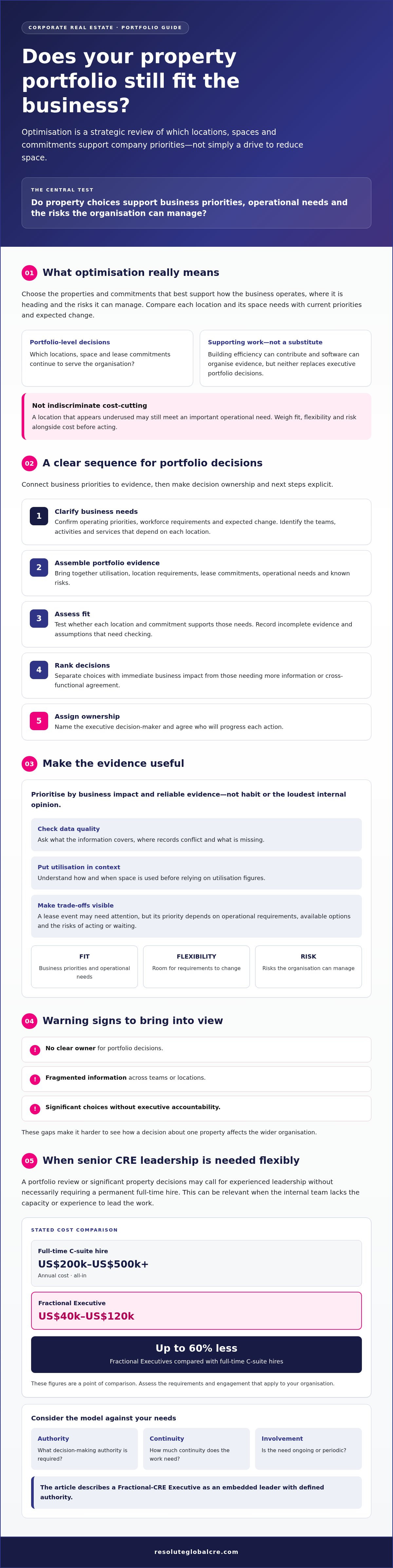
Corporate real estate portfolio optimisation means choosing the properties and commitments that best support how your business operates, where it is heading and the risks it can manage. It is a strategic discipline: deciding what the organisation needs from its portfolio, not simply reducing space or improving individual buildings.
The broader concept of Portfolio optimization considers how an asset mix can balance returns and risk. For occupiers, the test is different: do locations, space and lease commitments serve business priorities and operational requirements? Building-level efficiency improvements can contribute, and software can help organise evidence, but neither replaces executive decisions about the portfolio itself.
How to tell whether the portfolio still fits the business
Compare each location and its space needs with current priorities and expected change. Consider how the business operates, which teams need to work together, where activity must take place and how requirements could shift. The aim is not to predict every change. It is to check whether existing commitments leave the organisation room to respond.
Look for practical warning signs: no clear owner for portfolio decisions, information fragmented across teams or locations, and significant choices made without executive accountability. These gaps make it harder to understand how a decision about one property affects the wider organisation.
Optimisation is not indiscriminate cost-cutting. A location that appears underused may still serve an important operational need. Reducing space without examining its business role could create new risks. A sound review weighs fit, flexibility and risk alongside cost, then focuses attention on decisions with the clearest strategic consequences.
How to review and prioritise a corporate real estate portfolio
A useful review turns a broad question into a sequence of decisions. For corporate real estate portfolio optimisation, connect business priorities to evidence, then make ownership and next steps explicit.
Clarify business needs
confirm operating priorities, workforce requirements and expected change. Ask which teams, activities and services depend on each location.
Assemble portfolio evidence
gather information on utilisation, location requirements, lease commitments, operational needs and known risks.
Assess fit
test whether each location and commitment supports those needs. Record where evidence is incomplete or assumptions need checking.
Rank decisions
distinguish choices with an immediate business impact from those that need more information or cross-functional agreement.
Assign ownership
name the executive decision-maker and agree who will progress each action.
Set priorities using business impact and reliable evidence, not habit or the loudest internal opinion. A lease event may need attention, but its priority depends on operational requirements, available options and the risks of acting or waiting. Make the rationale visible so leaders can compare decisions consistently and understand the trade-offs across the portfolio.
Which evidence should guide portfolio priorities?
Check data quality before using analysis as a basis for action. Ask relevant teams what the information covers, where records conflict and what is missing. Utilisation figures, for example, need context about how and when space is used. Separate decisions supported by current evidence from questions that still need validation or cross-functional agreement.
This review may also surface connected work. Guidance on corporate real estate cost reduction and lease renewal strategy can help examine those decisions in greater depth. For occupier-focused, conflict-free CRE guidance, explore Resolute Global’s approach.
When Fractional-CRE expertise can support portfolio optimisation
Some portfolio decisions call for experienced leadership, but not necessarily a permanent full-time hire. An organisation undertaking a portfolio review, responding to changing business needs or managing significant property decisions may benefit from senior CRE expertise on a flexible basis. This can be particularly relevant when the internal team lacks the capacity or experience to lead the work.
Consider the authority, continuity and level of involvement the organisation needs, as well as whether that need is ongoing or periodic. The stated annual cost of a full-time C-suite hire is US$200k-US$500k+ (all-in), compared with US$40k-US$120k for a Fractional Executive. Fractional Executives cost up to 60 % less than full-time C-suite hires. These figures provide a point of comparison; assess the requirements and engagement that apply to your organisation.
Assessing the Fractional-CRE Executive model
A Fractional-CRE Executive is an embedded leader with defined authority, not an arm’s-length adviser or task-based contractor. They can work alongside an organisation’s leadership, provide occupier-focused and conflict-free guidance, and scale their involvement up or down as requirements change. More than 72 % of Fractional Executives have 15+ years of experience.
The model may suit organisations that need seasoned judgement for corporate real estate portfolio optimisation but do not require a full-time executive on an ongoing basis. Engagements can be completed in hours (we’ve done it in two hours). Confirm the scope, authority and context needed for your situation rather than assuming every engagement will follow the same timing.
To explore whether the Fractional-CRE platform fits your requirements, contact James McLean via www.ResoluteGlobalCRE.com, james.mclean@resoluteglobalcre.com or +44 7867 140785.
Make your next portfolio decision count
Corporate real estate portfolio optimisation is an ongoing discipline: connect property choices to business priorities, test decisions against reliable evidence and make accountability clear. This gives leaders a stronger basis for deciding what to retain, change or examine further, without defaulting to blanket cost-cutting.
Where senior CRE leadership is needed periodically, a Fractional-CRE Executive offers an alternative to a permanent full-time appointment. The model provides access to embedded leadership with defined authority, and engagements can be completed in hours (we’ve done it in two hours).
Explore whether this model fits your organisation’s needs. Explore the Fractional-CRE platform and speak with James McLean at james.mclean@resoluteglobalcre.com or +44 7867 140785.
Frequently Asked Questions
Is corporate real estate portfolio optimisation just about reducing costs?
No. Cost can be one consideration, but corporate real estate portfolio optimisation is about aligning property decisions with business priorities, operational requirements and risk. A location that appears costly may still be essential to how teams or services operate. Assess the role each property plays before deciding whether to retain, change or exit a commitment. A lower cost alone does not prove a better fit.
How do you start reviewing a corporate real estate portfolio?
Start by clarifying business needs and expected change, then gather evidence on locations, space use, lease commitments, operational requirements and risk. Assess how well the portfolio fits, rank decisions by business impact and assign an accountable owner to each action. Before relying on analysis, ask relevant teams to validate the data and identify gaps. Treat uncertain findings as questions to resolve, not established facts.
Can a mid-market organisation access senior CRE expertise without a full-time hire?
Yes. A Fractional-CRE Executive can provide senior expertise on a flexible basis when an organisation needs strategic leadership periodically but does not require a permanent full-time executive. The executive works as an embedded leader with defined authority, rather than as a consultant or task-based contractor. This can help connect portfolio decisions to business priorities while allowing the organisation to scale involvement as its needs change.
How quickly can a Fractional-CRE Executive be engaged?
Engagements can be completed in hours (we’ve done it in two hours). This describes the speed at which an engagement can be completed, not a universal timeframe or guarantee. Timing depends on the organisation’s requirements and the engagement to be agreed. Clarify the decision to be supported, the executive’s authority and the necessary context so the work can begin with a shared understanding.
Proudly Untraditional
We’re proudly untraditional in the way we think, operate, and deliver value in the Corporate Real Estate sector.
Whether you’re a client seeking a new experience or an independent real estate adviser please get in touch to learn more.
More from the field
Keep reading for more sharp analysis on global corporate real estate