
Retail Space Tenant Representation for UK Retailers
The key difference is whose interests the adviser serves. Retail space tenant representation in the UK means the adviser acts for the retailer, supporting the property search and lease negotiations. A landlord’s agent represents the property owner, while a tenant-side adviser keeps the retailer’s pr...



The key difference is whose interests the adviser serves. Retail space tenant representation in the UK means the adviser acts for the retailer, supporting the property search and lease negotiations. A landlord’s agent represents the property owner, while a tenant-side adviser keeps the retailer’s priorities at the centre of the process.
Choosing a shop is only one part of the decision. Rent-free periods, break clauses, service charges and permitted use can all affect a lease’s value and flexibility. Review these terms alongside the premises themselves, not just the location.
This guide explains how tenant representation works, what it can offer retailers and which lease terms deserve close attention. It covers break clauses and rent-free periods, too, so you can weigh your options with greater clarity and control.
Key Takeaways
• Understand whose interests each adviser represents, and how that shapes property searches, proposals and negotiations.
• Assess break clauses and rent-free periods as part of the lease’s overall flexibility and financial structure.
• Compare the full terms of shortlisted premises, not just headline rent, to see where independent tenant-side support can add value.
• Use occupier-focused guidance to bring clarity to property decisions and keep your business priorities at the centre of the process.
Lease terms, including break clauses and rent-free periods
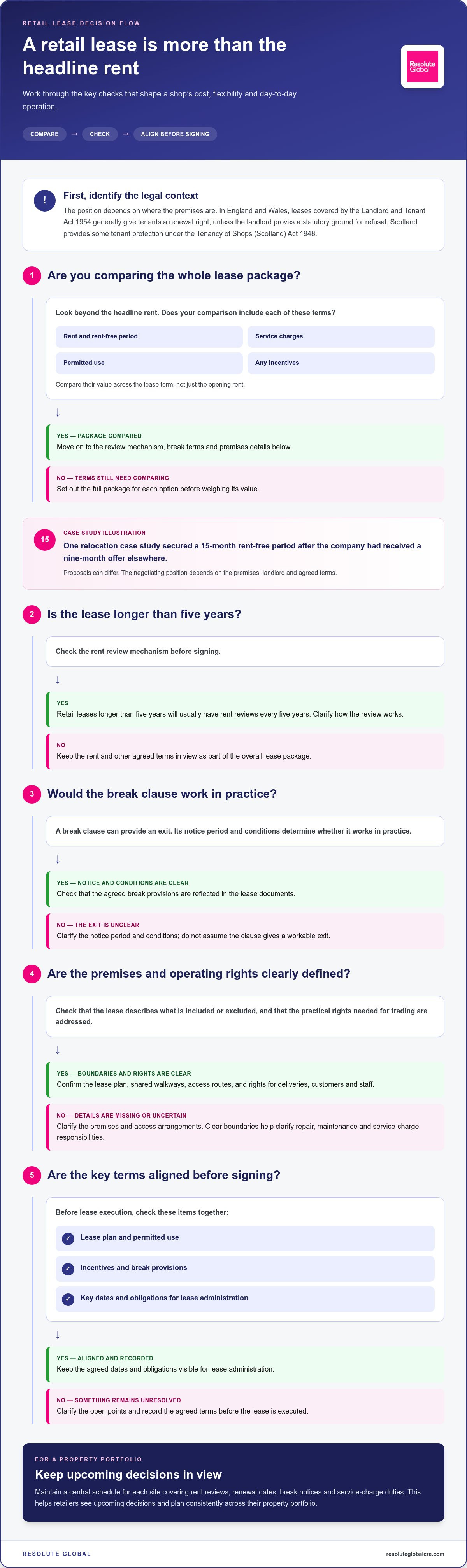
England and Wales retail leases sit under English common law and the Landlord and Tenant Act 1954. Scotland provides some tenant protection under the Tenancy of Shops (Scotland) Act 1948, so the legal position depends on where the premises are. In England and Wales, leases covered by the 1954 Act generally give tenants a renewal right, unless the landlord proves a statutory ground for refusal.
Negotiate the whole package, not just the headline rent. Set out the rent, rent-free period, service charges, permitted use and any incentives, then compare their value across the lease term. One relocation case study secured a 15-month rent-free period after the company had received a nine-month offer elsewhere. That illustrates how proposals can differ; the negotiating position depends on the premises, landlord and agreed terms. Retail leases longer than five years will usually have rent reviews every five years, so clarify the review mechanism before signing.
A break clause can provide an exit, but its notice period and conditions determine whether it works in practice. The same case study secured a tenant-friendly break at year five, without penalty conditions. Define the premises precisely, including what is included or excluded, shared walkways and access routes. Clear boundaries help clarify repair, maintenance and service-charge responsibilities. Rights for deliveries, customers and staff also matter to day-to-day trading.
Manage the transaction from the initial search through negotiation and lease execution. Before signing, align the lease plan, permitted use, incentives and break provisions, then record key dates and obligations for lease administration. For a portfolio, maintain a central schedule of rent reviews, renewal dates, break notices and service-charge duties for each site. This helps retailers see upcoming decisions and plan consistently across their property portfolio.
What is the difference between Tenant representation and Landlord representation?
A tenant representative acts for the retailer, while a landlord’s agent is instructed by the property owner. The tenant adviser can support the transaction from the initial search through lease execution, sourcing proposals and negotiating terms in line with the retailer’s interests. The landlord’s agent markets space for the owner. The distinction is whose interests guide each stage.
Fees and commission vary by engagement, so there is no single UK rate. Before appointing an adviser, review the written fee basis. Clarify whether it is fixed, commission-based or structured another way, what work it covers and when payment is due.
Finding and leasing a shop follows a clear sequence. First, define the required location, size, permitted use and operational needs. Then search for suitable opportunities and source proposals. Compare shortlisted premises for location, lease terms and overall suitability before negotiating the preferred proposal and progressing towards lease execution. For each option, record how it meets or misses the retailer’s requirements.
Market analysis also helps retailers assess asking rents against comparable premises and understand how location, condition and lease terms affect value. A specialist adviser can organise that evidence and present a clearer negotiating position. The same search discipline applies to office property searches and acquisitions, although retail assessments must account for customer access and trading requirements. For a more structured approach to retail property market analysis, bring the search criteria and proposals into one decision process.
Tenant representation benefits
Tenant representation gives retailers an adviser focused on occupier interests throughout a property transaction. That alignment matters when a landlord’s proposed terms reflect the owner’s priorities. Retail space tenant representation in the UK can help retailers assess proposals against market evidence, spot clauses that may shift risk and relate decisions to trading requirements. The value is a clearer basis for negotiation, not simply a lower headline rent.
Commercial relocation examples illustrate why independent analysis matters. A London technology-company case study reports a headline rent negotiated 12% below the company’s best previous terms. In a separate King’s Cross example, a technology company was paying roughly 15% above prevailing market rent when it signed its lease. These examples are not retail outcomes, but show how occupiers can misjudge their market position without relevant comparisons.
For retailers, an adviser can assess shortlisted premises for location, trading suitability, total lease obligations and flexibility. Retail space tenant representation in the UK also supports a consistent review of rent, service charges, repair responsibilities, break clauses and renewal provisions. Considering these together can show how one clause affects the wider commitment, even when the headline terms look competitive.
Tenant-side support can bring structure to discussions with landlords. An adviser can coordinate proposal reviews, record agreed changes and track decisions through lease completion, keeping commercial points visible as documents progress. When retailers are weighing several buildings, consistent analysis makes trade-offs easier to explain internally and supports a considered decision.
Build a stronger occupier-side plan for your next property decision with retail lease advisory support.
Resolute Global: Occupier-focused CRE Guidance
Resolute Global provides occupier-focused CRE guidance for retailers considering a new lease, relocation or renewal. Turn to this support when you need a clearer view of property options and lease decisions, and how each choice aligns with your business priorities.
Resolute Global’s Global Real Estate Advisory Network offers a broader perspective across property markets, while its Conflict-free Real Estate Solutions focus on occupier needs. Together, these offerings help retailers move from property questions to informed decisions while keeping their interests central.
Bring your requirements and priorities into the conversation to explore an advisory approach for your retail property decisions. Visit resoluteglobalcre.com to learn more about working with Resolute Global.
Set your next property decision in motion
Start with a concise brief covering your trading priorities, preferred locations and desired lease outcomes. A clear mandate helps your team assess property choices with confidence. Retail space tenant representation in the UK can support an occupier-led approach, keeping your objectives at the centre of the process.
Resolute Global offers occupier-focused CRE guidance, a Global Real Estate Advisory Network and Conflict-free Real Estate Solutions. These services provide a focused basis for considering your property requirements and the advisory support that fits them.
When you’re ready to discuss your retail property priorities, contact Resolute Global about retail space. Take the next step with clarity and confidence.
Frequently Asked Questions
Can my existing agent also represent me as a tenant?
Possibly, if the agent accepts a clear tenant-side instruction and can act in your interests without conflicting obligations. Before proceeding, establish whom the agent represents for each property and how any existing landlord relationship affects the assignment. If the agent represents the owner of your preferred premises, clarify how the overlap will be handled before sharing confidential negotiating information.
Do I need a tenant representative for a commercial lease?
No, you can approach a landlord or their agent directly. Tenant representation may help if your team lacks the time or experience to assess several proposals, compare lease risks or manage discussions alongside day-to-day trading. A straightforward renewal on familiar terms may need less support than a relocation involving multiple sites, different uses or complex operational requirements.
What does a tenant-only adviser do differently?
A tenant-only adviser works exclusively for occupiers and does not represent landlords. This focus allows the adviser to assess proposals from the retailer’s perspective, including how terms affect planned trading, future flexibility and internal approval. Set out the adviser’s role and scope in writing, so everyone understands which decisions they support and who has authority to approve the lease.
Why choose a tenant-only firm over a full-service agency?
Choose a tenant-only firm when independence from landlord instructions is central to your property decision. A full-service agency may act for different parties under separate instructions, while a tenant-only model focuses on occupier interests. The practical distinction is the adviser’s mandate: decide whether you want support shaped solely around your requirements, rather than advice across both sides of the property market.
What does a UK retail tenant representation agent do?
A UK retail tenant representation agent helps occupiers find and assess premises and progress a transaction towards lease completion. For a retailer, this can include checking whether the permitted use suits the intended business, assessing access for deliveries and customers, and considering how redevelopment could affect the store. The adviser’s remit is to keep property decisions aligned with the retailer’s operating needs.
Proudly Untraditional
We’re proudly untraditional in the way we think, operate, and deliver value in the Corporate Real Estate sector.
Whether you’re a client seeking a new experience or an independent real estate adviser please get in touch to learn more.
More from the field
Keep reading for more sharp analysis on global corporate real estate