
Commercial property market analysis for tenant fit
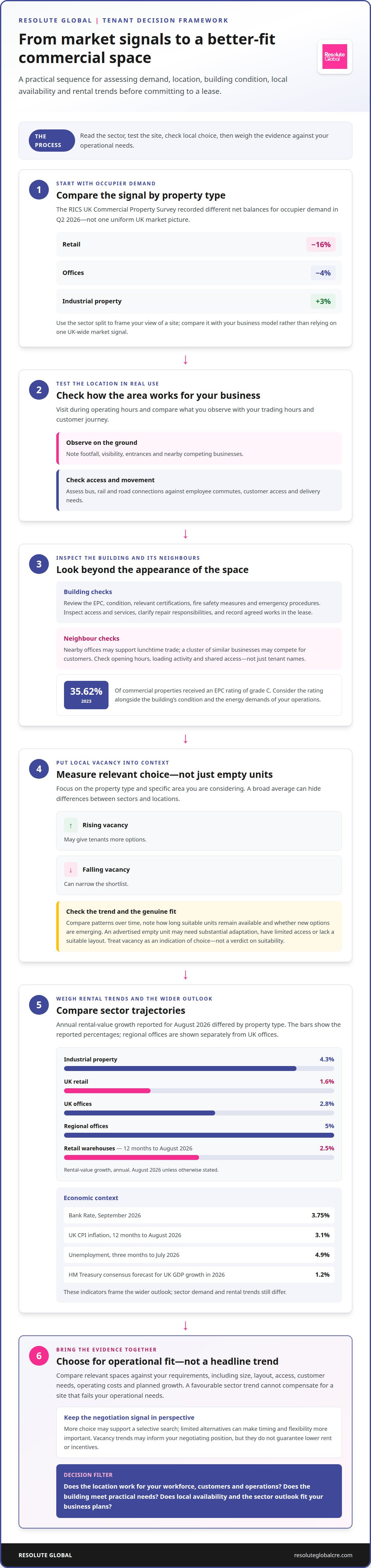
UK occupier demand diverged in Q2 2026: the net balance was -16% for retail, -4% for offices and +3% for industrial property. A commercial property market analysis for tenants brings these market signals together with location, building condition, nearby occupiers and local vacancy rates to assess w...



UK occupier demand diverged in Q2 2026: the net balance was -16% for retail, -4% for offices and +3% for industrial property. A commercial property market analysis for tenants brings these market signals together with location, building condition, nearby occupiers and local vacancy rates to assess whether a space fits your business. It’s more than comparing rents; it’s about understanding the forces that could shape a lease decision.
Choosing a suitable building is only part of the decision. The harder question is how current market conditions and UK forecasts affect your options as a tenant. This guide explains how to assess property condition, nearby occupiers and vacancy data alongside changes in demand and rents, helping you make a more informed decision about your next commercial space.
Key Takeaways
• Assess whether a location supports your workforce, customers and operations, not just whether the building looks suitable.
• Look beyond the property itself: its condition, safety arrangements and neighbouring occupiers can all affect day-to-day fit.
• Use local vacancy patterns to understand choice and market pressure, then compare them with the needs of your business.
• Read forecasts by property type and occupier demand to frame your decision, rather than relying on a single UK-wide market signal.
Property location, condition and nearby tenants
Visit the area during operating hours and note footfall, visibility, entrances and nearby competing businesses. Assess bus, rail and road connections against employee commutes, customer access and delivery needs. Then compare what you observe with your trading hours and customer journey.
Before signing, review the EPC, building condition, relevant certifications, fire safety measures and emergency procedures. Inspect access and services, clarify repair responsibilities, and record agreed works in the lease. This helps identify practical constraints before occupation, including whether the space can support your employees and daily operations.
Nearby occupiers can signal how a location functions: offices may support lunchtime trade, whilst a cluster of similar businesses may compete for customers. Check opening hours, loading activity and shared access, not just tenant names. In 2023, 35.62% of commercial properties received an EPC rating of grade C. Consider the rating alongside the building’s condition and the energy demands of your operations.
Economic conditions also shape rental demand, investor confidence and financing decisions. The Bank of England held Bank Rate at 3.75% in September 2026. UK CPI inflation was 3.1% in the 12 months to August 2026, whilst unemployment was 4.9% in the three months to July 2026. The September 2026 HM Treasury consensus forecast UK GDP growth of 1.2% in 2026. These indicators frame the wider outlook, but sector demand differs: the RICS UK Commercial Property Survey recorded net balances of -16% for retail, -4% for offices and +3% for industrial occupier demand in Q2 2026. Compare that split with your business model before judging a site’s prospects.
Commercial property vacancy rates by location
Vacancy rates are most useful when they relate to the property type and specific area you are considering. A broad market average can obscure differences between office, retail and industrial space, or between a busy high street and a quieter business park. Treat the figure as an indication of choice, not a verdict on suitability.
Compare vacancy patterns over time rather than relying on a single snapshot. A rising rate may give tenants more options, while a falling rate can narrow the shortlist. Consider the trend alongside the availability of spaces that match your size, layout and operational requirements.
Distinguish advertised availability from a genuine fit. An empty unit may require substantial adaptation, have limited access or lack a layout that suits your team. Conversely, even a small pool of available properties may include a strong match for your intended use.
Use vacancy data to focus your search: define the property type, target area and essential features, then compare relevant spaces. Note how long suitable units remain on the market and whether new options are emerging. This puts local supply in context for your decision.
Consider what vacancy trends could mean for your negotiating position, but do not assume they guarantee lower rent or incentives. More choice may support a selective search; limited alternatives can make timing and flexibility more important. Weigh these signals against your operational priorities.
A tenant-side review can turn local availability into clearer occupancy decisions, using conflict-free real estate solutions to keep the focus on occupier needs.
UK commercial property market forecasts
UK forecasts point to different trajectories by property type, rather than one uniform real estate cycle. This long-term outlook is a reason to compare lease commitments with planned growth, instead of treating current rents as the whole picture. Supply, location and building suitability still shape the opportunities available to each business.
Recent rental trends also vary by sector. Average annual industrial rental value growth was 4.3% in August 2026, while UK retail rental values rose 1.6% annually. Average UK office rental value growth was 2.8% in August 2026, compared with 5% across the wider regional office market. These differences can guide target-location comparisons: an occupier seeking office space may find regional markets moving differently from the national average.
Retail warehouses offer another distinct signal: average UK rental values grew 2.5% in the 12 months to August 2026. For tenants, the practical action is to test forecasts against business requirements, including customer access, operating costs and lease flexibility. A favourable sector trend cannot compensate for a site that fails operational needs.
Economic shifts also shape confidence. Brexit and the COVID-19 pandemic affected UK supply, demand, rental values and investment patterns. In Q4 2024, the RICS UK Commercial Property Monitor reported stagnating tenant demand and a more cautious investment climate. Treat these factors as context, then assess sustainability and property performance alongside sector data. For a forward-looking occupier strategy, align property decisions with your business plans.
Rental-value growth in August 2026 was 4.3% for industrial property, 1.6% for UK retail and 2.8% for UK offices, compared with 5% for regional offices; retail warehouses recorded 2.5% growth over the 12 months to August 2026.
Resolute Global: Occupier-focused CRE Guidance
Resolute Global provides occupier-focused Corporate Real Estate guidance for businesses weighing location, lease terms and market forecasts. Turn to this support when the evidence points in different directions or property decisions need to align with wider business plans. The aim is to give occupiers a clearer basis for comparing options and deciding what matters most.
For businesses assessing property needs across markets, Resolute Global’s global network of advisors brings a broader perspective. Its occupier-only advice keeps your priorities at the centre as you evaluate your next move.
Contact Resolute Global to discuss your commercial property decision.
Make your next property decision with clarity
A commercial property market analysis for tenants is most useful as a working decision framework, not a one-off review. Define what your business needs from its next space, which trade-offs are acceptable and what would prompt you to reconsider. Revisit those priorities as your operations, workforce and growth plans evolve.
This discipline helps connect property decisions to business strategy, rather than short-term pressure or market sentiment alone. Before committing to a direction, bring key decision-makers together, agree on the criteria that matter most and decide how you will assess each option.
Resolute Global can help occupiers shape their next steps. Start a conversation about your property plans, and move forward with greater clarity and confidence.
Frequently Asked Questions
What Is a Market Analysis in Real Estate?
A real estate market analysis compares a property with local conditions to inform an occupancy decision. For tenants, a commercial property market analysis can assess comparable spaces, demand, vacancy, lease terms and how well a building supports business operations. For example, compare similar office units in the same submarket, adjusting for condition, access and included services before assessing value.
What are the most critical factors in commercial property research?
Prioritise operational fit, total occupancy obligations and flexibility. Check that the permitted use supports your activities, the floorplate can accommodate your team, and the lease allows for likely changes. For a distribution business, loading access and storage capacity may matter more than a polished reception; for a customer-facing business, visibility and access may carry greater weight.
What are current UK commercial property market trends for tenants?
Recent indicators show differing patterns across sectors. UK industrial property vacancy was expected to peak in 2026 and then begin to decline, whilst average UK shopping-centre rental values increased by 0.5% over the three months to August 2026. For tenants, these signals make sector-specific planning more useful than assuming one national trend applies to every property.
How do commercial rents and availability compare across major UK cities?
Rents and availability vary by property type, submarket and building specification, so compare like with like. Start with spaces serving the same purpose, noting floor area, condition, lease terms and access. Then compare availability and total occupancy costs, including service charges. A lower headline rent may not offer better value if the space requires substantial adaptation.
What additional costs do UK commercial tenants pay besides rent?
Besides rent, tenants may pay service charges for items such as security, cleaning, maintenance, management, utilities and insurance.
Proudly Untraditional
We’re proudly untraditional in the way we think, operate, and deliver value in the Corporate Real Estate sector.
Whether you’re a client seeking a new experience or an independent real estate adviser please get in touch to learn more.
More from the field
Keep reading for more sharp analysis on global corporate real estate


