
The Ultimate Real Estate Portfolio Consolidation Strategy Checklist for 2026
With UK regional office vacancy rates sitting at 10.5% and industrial vacancies rising above historical averages, the pressure to rationalise your footprint has never been more acute. You likely recognise the burden of holding underutilised space whilst facing rising costs in prime markets where ren...


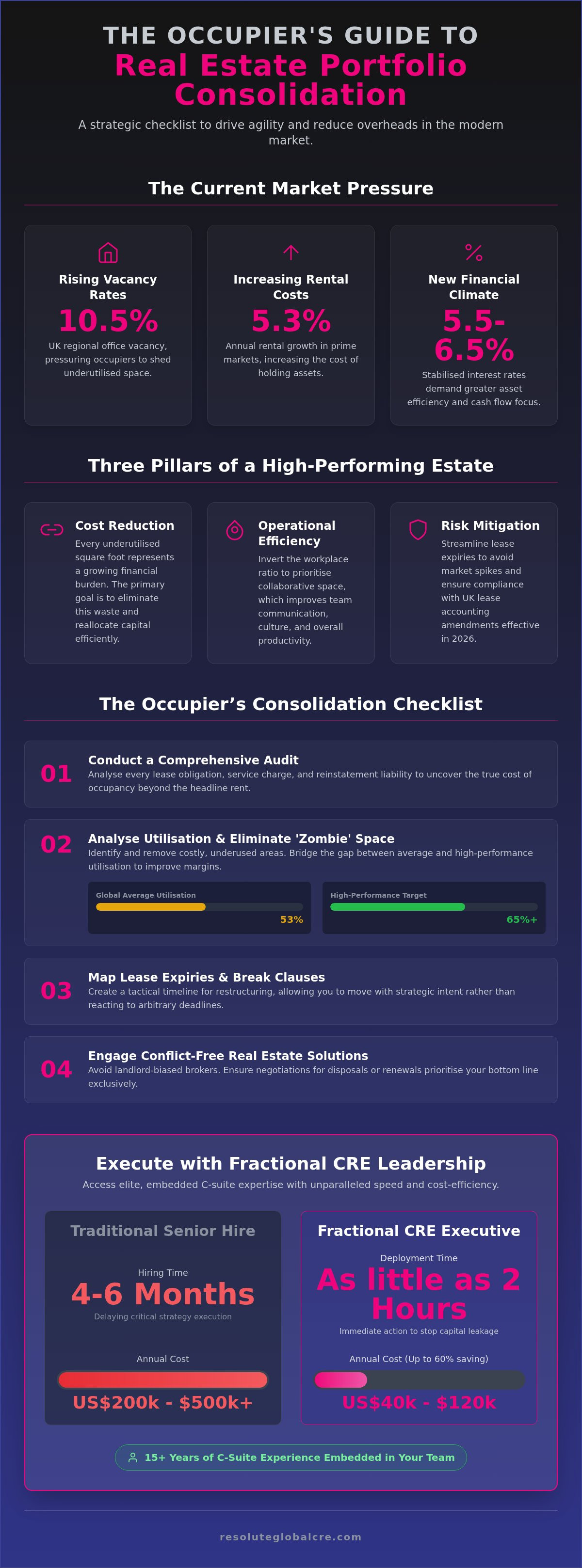
With UK regional office vacancy rates sitting at 10.5% and industrial vacancies rising above historical averages, the pressure to rationalise your footprint has never been more acute. You likely recognise the burden of holding underutilised space whilst facing rising costs in prime markets where rental growth has reached 5.3% annually. Developing a robust real estate portfolio consolidation strategy is no longer a luxury; it's a critical mechanism for the modern occupier. This guide delivers a surgical checklist designed to drive agility and reduce overheads through the use of expert fractional leadership. We'll outline how to move from a bloated, static model to a leaner, more responsive organisation. You'll gain a clear roadmap for lease disposals and renewals that prioritises your bottom line over traditional, rigid structures. The era of the unencumbered, highly responsive occupier has arrived.
Key Takeaways
• Master a future-proof real estate portfolio consolidation strategy that prioritises operational agility over the rigid, long-term commitments of the past.
• Learn how to conduct a surgical audit of your Corporate Real Estate assets to identify and eliminate "zombie" space that is quietly eroding your margins.
• Explore the Fractional-CRE model to access embedded leaders with 15+ years of experience who can execute complex lease disposals at a fraction of the traditional cost.
• Gain a clear roadmap for right-sizing your global footprint to match actual utilisation data rather than outdated pre-pandemic standards.
Mastering the Real Estate Portfolio Consolidation Strategy: Why Agility Wins
A real estate portfolio consolidation strategy is the surgical reorganisation of assets to improve capital efficiency. It's the bridge between a bloated historical footprint and a future-ready operation. In 2026, the market has stabilised at higher interest rates between 5.5% and 6.5%, ending the era of cheap, sub-3% financing. This shift forces a greater focus on asset quality and cash flow. Whilst traditional real estate investment strategies often prioritised long-term accumulation, modern occupiers must prioritise the ability to scale down or pivot as operational needs fluctuate. Embracing this agility is the only way to execute a successful real estate portfolio consolidation strategy in the current climate.
Independence is vital. Traditional brokers often suffer from dual-agency conflicts, where their ties to landlords can compromise the quality of occupier advice. A truly conflict-free approach ensures your consolidation serves only your bottom line. It's about transparency and bespoke guidance that avoids the cold, impersonal nature of larger institutions.
The Core Drivers of Portfolio Optimisation in 2026
Success requires focusing on three specific pillars of value that define a high-performing estate.
Cost reduction
With national prime rental growth averaging 3%, every underutilised square foot represents a growing financial burden that erodes margins.
Operational efficiency
Inverting the workplace ratio to prioritise collaborative space improves communication and culture amongst teams.
Risk mitigation
Streamlining lease expiries avoids market spikes and ensures compliance with UK lease accounting amendments effective in 2026.
The Occupier’s Checklist for Portfolio Optimisation and Consolidation
Executing a real estate portfolio consolidation strategy requires surgical precision rather than broad strokes. It starts with a comprehensive audit of every lease obligation, service charge, and reinstatement liability across your global footprint. You must look beyond the headline rent to uncover the true cost of occupancy. Hidden costs often lurk in historical lease clauses that no longer serve your operational goals.
Next, analyse space utilisation data to identify "zombie" space. These are the quiet corners of your estate that cost money without adding value. Current research shows global building utilisation is averaging 53%, yet most high-performing organisations target over 65%. If your data reveals a gap, you're effectively subsidising empty square footage that could be stripped away to improve your margins.
Mapping lease expiries and break clauses is your third priority. This creates a tactical timeline for restructuring, allowing you to move with intent rather than reacting to arbitrary deadlines. Finally, engage conflict-free Real Estate Solutions to handle negotiations. Avoiding landlord-biased brokers ensures your interests remain the sole priority during disposals or renewals. It's about securing the best terms for the occupier, always.
Critical Data Points for Your Consolidation Audit
Success is found in the granular details of your estate's performance metrics.
Total Occupancy Cost (TOC) per head
Benchmark this against your sector to identify outliers that require immediate attention.
Utilisation rates
Companies are now right-sizing to 100-120 square feet per employee to match peak occupancy.
ESG compliance
Evaluate which assets require significant capital to meet 2027 standards. Older, lower-grade properties often become "stranded assets" that hinder your long-term consolidation goals.
Executing Consolidation with Fractional Corporate Real Estate Leadership
Traditional hiring cycles for senior leadership are notoriously sluggish. Finding a permanent head of Corporate Real Estate often takes 4-6 months. This delay is unacceptable when your real estate portfolio consolidation strategy requires immediate execution to stop capital leakage. The Fractional-CRE Executive model offers an elite alternative. It allows you to deploy embedded leaders with over 15 years of experience in as little as two hours. These professionals possess the deep C-suite "pattern recognition" needed to navigate complex global restructures without the friction or bureaucracy of a permanent hire.
The financial advantage is undeniable. A Fractional Executive typically costs between US$40k and US$120k annually. This represents a saving of up to 60% compared to the US$200k to US$500k+ required for a full-time senior hire. You gain high-tier capability without the long-term burden on your payroll. It is a more intelligent, streamlined way of operating. Speed meets precision.
Why Fractional Executives Outperform Traditional Consultants
Embedded leaders offer a level of accountability that external consultancies simply cannot match. Whilst a consultant might deliver a report and depart, a Fractional Executive stays to own the outcome.
Defined authority
They operate as part of your internal team, possessing the mandate to execute disposals and manage renewals directly.
Cost-effective scaling
You can scale the engagement up or down as the consolidation programme reaches key milestones. Flexibility is built in.
Conflict-free outcomes
They are unencumbered by landlord-side commissions, ensuring every decision serves the occupier's bottom line.
Securing Your Competitive Advantage in a Fluid Market
Transitioning toward an agile estate is no longer optional. By implementing a data-driven real estate portfolio consolidation strategy, you transform your property footprint from a static liability into a responsive asset. You've identified the "zombie" space and mapped your tactical exit timeline. Now, execution is the final hurdle. Elite leadership shouldn't be gated by six-month recruitment cycles or rigid overheads.
Success requires an embedded partner. Over 72% of our Fractional Executives bring more than 15 years of senior Corporate Real Estate experience to your organisation. We provide the surgical precision needed to reduce costs whilst maintaining momentum. Engagements begin in as little as two hours, allowing you to move at market speed.
Access elite Fractional-CRE expertise within hours to lead your consolidation strategy.
The path to a leaner portfolio is open. Take the first step toward an agile future today.
Frequently Asked Questions
What is the difference between portfolio consolidation and downsizing?
Portfolio consolidation is a strategic reorganisation of assets to improve efficiency, whilst downsizing is the simple reduction of total square footage. A real estate portfolio consolidation strategy might involve moving multiple teams into a single, high-quality hub to foster better culture. It's about building a leaner, more agile footprint that supports growth rather than just cutting costs to survive.
How long does a real estate portfolio consolidation strategy take to implement?
Implementation timelines vary based on your specific lease expiries and break clauses. Whilst the initial audit and strategy phase can be completed in weeks, the full execution often aligns with your tactical exit roadmap. Engaging a Fractional-CRE Executive accelerates this process significantly. They can be deployed in as little as two hours to begin identifying immediate savings across your global estate.
Why should I use a Fractional-CRE Executive instead of a traditional consultant?
Fractional Executives are embedded leaders with defined authority to execute your strategy, whereas consultants typically provide arm's-length advice. Over 72% of our executives possess 15+ years of senior Corporate Real Estate experience. They cost up to 60% less than full-time hires and focus entirely on the occupier's bottom line. You get senior-level pattern recognition without the friction of traditional consultancy models.
Can portfolio consolidation help with my company’s ESG goals?
Consolidation is a primary driver for achieving ESG targets. By shedding older, lower-grade properties that require significant capital to meet 2027 standards, you reduce your organisation's carbon footprint. Moving into modern, amenity-rich buildings often improves energy efficiency and employee well-being. It's a surgical way to ensure your portfolio remains compliant whilst also lowering your total occupancy costs.
Proudly Untraditional
We’re proudly untraditional in the way we think, operate, and deliver value in the Corporate Real Estate sector.
Whether you’re a client seeking a new experience or an independent real estate adviser please get in touch to learn more.
More from the field
Keep reading for more sharp analysis on global corporate real estate


