
Strategic Corporate Real Estate Cost Reduction: An Occupier-Only Framework for 2026
The traditional brokerage model is fundamentally broken because it serves two masters, yet expects the tenant to pay the bill. If you're managing a portfolio in the current climate, you've likely realised that the advice you receive is often coloured by the very interests you're trying to negotiate...


The traditional brokerage model is fundamentally broken because it serves two masters, yet expects the tenant to pay the bill. If you're managing a portfolio in the current climate, you've likely realised that the advice you receive is often coloured by the very interests you're trying to negotiate against. This lack of transparency is a direct barrier to effective corporate real estate cost reduction, costing British businesses millions in unnecessary overheads and inflexible commitments. You're right to feel that your property strategy should be as agile as your operations. Agility is the new currency.
Achieving a leaner portfolio in 2026 requires more than just trimming the edges of a budget; it demands a total pivot towards an occupier-only framework. We'll show you how to eliminate hidden property costs and maximise portfolio agility through conflict-free advisory and fractional expertise. You'll discover a leaner, more intentional way of operating that aligns your real estate spend with actual business usage. We'll examine why the move away from big-brokerage bias is the only way to secure a portfolio that truly works for you. It's time for a better way.
Key Takeaways
• Learn why adopting "Efficiency as a Strategy" is essential for navigating the unique economic pressures and interest rate legacy of 2026.
• Discover how removing the "Dual Agency" conflict through independent advisory creates a transparent path for corporate real estate cost reduction.
• Understand the value of Fractional CRE in accessing elite, C-suite property strategy whilst eliminating the overhead of a permanent high-level headcount.
• Uncover hidden savings within your current portfolio by applying lease forensic audits and the four pillars of tactical restructuring.
• Explore the methodology for building a more agile property portfolio that aligns precisely with actual business usage and operational demand.
The 2026 Landscape: Why Corporate Real Estate Cost Reduction is Paramount
The economic environment of 2026 presents a stark departure from the era of cheap capital and expansionary zeal. High interest rates have left a lasting legacy on debt servicing, whilst energy costs and inflationary pressures have permanently recalibrated the cost of operating physical space. For many UK businesses, the old mantra of "Growth at all costs" has been replaced by a more disciplined philosophy: Efficiency as a Strategy. Corporate real estate cost reduction is no longer a seasonal exercise in belt-tightening; it's a fundamental requirement for operational survival. Traditional real estate models, often built on rigid, long-term commitments and landlord-biased advice, are failing to provide the agility that modern occupiers demand. You need a portfolio that breathes with your business. Transforming property from a static liability into a dynamic business driver is the hallmark of the modern Occupier Advantage.
The Convergence of Talent and Cost
While the "war for talent" once dictated expansive, premium office footprints, the narrative has shifted significantly. Executives now face the complex challenge of maintaining a high-tier employee experience whilst aggressively reducing wasted square footage. This isn't about creating a sparse, uninviting environment. Instead, it's about the "Product-Led Workplace." This design philosophy ensures every square metre serves a specific, measurable purpose, eliminating the "dead zones" that plague unmanaged portfolios. By focusing on quality over quantity, you can provide an elite environment that attracts top talent without the burden of excess capacity. It's a surgical approach to space that prioritises the user's journey over sheer volume. Efficiency doesn't have to mean austerity; it means intentionality.
Identifying the True Cost of Occupancy
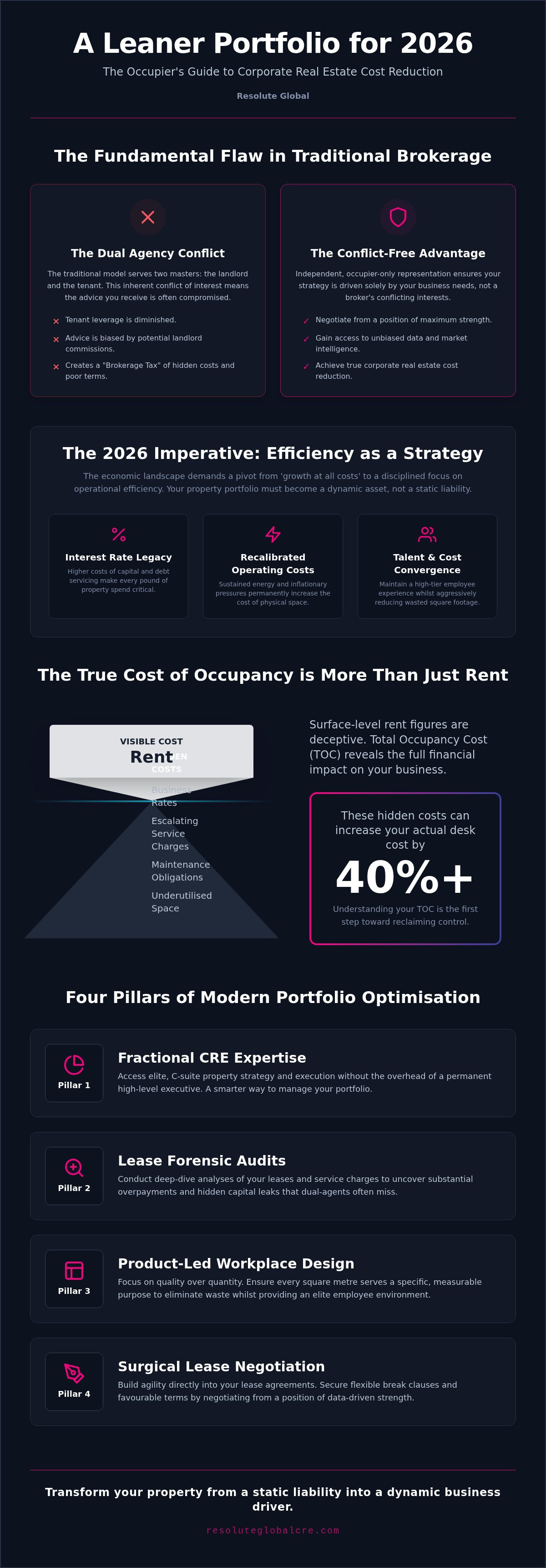
Surface-level rent figures rarely tell the full story of a property's impact on the balance sheet. In the UK market, business rates, escalating service charges, and maintenance obligations can often swell the actual cost of a desk by 40% or more. Underutilised space is the silent killer of profitability. If your office utilisation sits at 50% or below, you aren't just paying for empty desks; you're subsidising a landlord's asset at the expense of your own margins. You must look deeper into lease forensic audits to uncover where capital is leaking. Total Occupancy Cost (TOC) is the definitive baseline for all 2026 strategies, encompassing every penny spent from rent and rates to utilities and facilities management. Understanding this figure is the first step toward reclaiming control and achieving meaningful corporate real estate cost reduction.
Uncovering Value through Conflict-Free Tenant Representation
The standard brokerage model is built on a fundamental conflict. When your advisor also represents the landlord down the street, your leverage evaporates. This is the Dual Agency problem, and it's a primary reason why many UK firms overpay for their space. True corporate real estate cost reduction begins by choosing an ally who isn't playing both sides. Independent, tenant-only representation ensures your strategy is driven by your operational needs, not by which building pays the highest commission.
Knowledge is the differentiator. Landlords rely on information asymmetry. They know the true vacancy rates and the specific incentives their competitors are offering to fill space. An unbiased advisor brings this data to your side of the table, allowing you to negotiate from a position of absolute strength. Unbiased lease audits and service charge reviews often uncover substantial overpayments that dual-agents might overlook to avoid upsetting their landlord clients. These recoveries are low-hanging fruit for any firm serious about their financial health.
The Hidden Costs of Dual Agency
Conflicts of interest aren't always obvious. They manifest as "soft" advice to accept a slightly higher rent or a less flexible break clause. This is the Brokerage Tax. It's an invisible drain on your capital that directly undermines any attempt at corporate real estate cost reduction. Ensuring your advisor has a legal and ethical mandate to serve only you is the only way to protect your bottom line. This approach is independent, principled, and highly selective, ensuring your capital is protected at every turn. Transparency is the mandate.
Surgical Lease Negotiation Strategies
Agility is built into the lease, not added later. In a market where office vacancy remains a concern for landlords, occupiers have significant leverage. We use this to secure extended rent-free periods and capital contributions for fit-outs. Key terms like Break Clauses and Assignment Rights are non-negotiable for future agility. Accessing off-market data and real-time transaction evidence allows you to challenge landlord assumptions. We don't just ask for better terms; we demand them based on a comprehensive understanding of the current market reality. Industry analysis indicates that conflict-free advisors typically secure terms 15-20% more favourable than those brokered by dual-agents. Securing your interests requires a partner unburdened by landlord loyalties. By opting for conflict-free real estate solutions, you ensure that every negotiation is a surgical strike on behalf of your P&L.
Fractional CRE Services: Elite Strategy Whilst Reducing Overheads
Maintaining a dedicated, full-time executive for property strategy is often an expensive anachronism for the modern enterprise. Fractional Corporate Real Estate (CRE) provides a sophisticated alternative, offering C-suite expertise through a flexible, project-based mandate. This model allows you to inject high-tier strategic thinking into your business exactly when it's required, without the persistent drag of a permanent executive salary. It's a surgical approach to leadership. By utilising our Global Real Estate Advisory Network, you gain access to a world-class team of specialists who understand local market nuances across the globe. You get the reach of a multinational conglomerate with the agility of a boutique firm. This flexibility is a cornerstone of meaningful corporate real estate cost reduction, ensuring your professional spend is always aligned with your current project requirements.
The Fractional Head of Real Estate
Mid-market and rapidly scaling firms are increasingly abandoning the traditional full-time Head of Real Estate role in favour of more nimble structures. A fractional leader provides the same level of strategic foresight and negotiation prowess as a permanent hire, but they operate on a mandate that fits your actual needs. They aren't bogged down by internal politics or administrative inertia. Instead, they bring fresh, cross-industry insights that internal teams often lack, having seen how diverse sectors handle similar portfolio challenges. This external perspective is invaluable when restructuring leases or entering new territories. You pay for the strategy, not the seat. It's a more intelligent way to manage a portfolio whilst keeping fixed headcount costs to an absolute minimum.
Reducing Administrative and Management Burden
Global expansion often brings a chaotic mix of local brokers, conflicting advice, and fragmented reporting. We simplify this complexity through a Single Point of Contact model. By outsourcing the management of your global transactions to an agile network, you eliminate the need for a massive internal property department. We handle the heavy lifting, from initial site selection to final lease execution, ensuring consistent standards across every territory. A clear cost-benefit analysis usually reveals that Fractional CRE fees represent a fraction of the total cost of a full-time executive, when you account for bonuses, benefits, and national insurance. Scaling your real estate team up or down based on specific project cycles ensures that your overheads never outpace your operational needs. This unencumbered model is the ultimate tool for corporate real estate cost reduction in a volatile market. You remain responsive, lean, and focused on your core business goals.
Tactical Portfolio Optimisation: From Data to Restructuring
Data is the bedrock of any credible corporate real estate cost reduction programme. Without precise metrics, strategy is merely guesswork. We approach portfolio optimisation through the Four Pillars: Data, Design, Disposal, and Demand. This framework ensures that every decision is backed by evidence and aligned with your operational reality. A Lease forensic audit serves as your first line of defence, identifying historical overpayments in service charges, incorrect business rates assessments, and untapped recovery opportunities. It's about reclaiming capital that is rightfully yours. Once the baseline is established, we move from passive observation to active restructuring, transforming your footprint into a lean, responsive asset.
Data Accuracy and Utilisation Metrics
Allocated space is often a ghost in the machine. While your floor plans might suggest a full house, occupancy sensors and Wi-Fi tracking data frequently reveal a different story. These tools pinpoint "dead zones" where expensive square footage sits idle for 70% of the working week. Understanding the chasm between Allocated Space and Utilised Space is critical. By implementing dynamic seating ratios and flexible desking policies, businesses can often reduce their required square footage by up to 30% without impacting productivity. This isn't about crowding; it's about intelligent calibration. We use this data to design environments that reflect how your people actually behave, not how they used to work five years ago. Efficiency is the natural byproduct of accuracy.
Lease Disposal and Restructuring Tactics
Restructuring is where strategy meets the balance sheet. IFRS 16 has fundamentally changed the game, turning property from an off-balance sheet footnote into a central financial metric that affects your gearing and EBITDA. We look for every opportunity to mitigate these liabilities. Subletting can act as a vital cost-recovery mechanism, though it requires careful navigation of head-lease covenants and tenant reputations. For sites you wish to retain, we negotiate "Blend and Extend" deals. These agreements allow you to reduce immediate rental outgoings in exchange for a longer commitment, providing instant relief to your P&L. Whether it's exercising a break clause with surgical precision or negotiating a surrender, every move is designed to enhance your agility. Secure your portfolio's future by engaging with our occupier-focused CRE guidance today. We ensure your leases are as flexible as your business needs them to be.
Securing Your Bottom Line: The Resolute Global Approach
Resolute Global operates at the intersection of elite strategy and operational agility. We don't believe in the one-size-fits-all approach favoured by traditional institutions. Instead, we deliver bespoke, occupier-centric outcomes that reflect the specific nuances of your business. Our Global Advisory Network provides the necessary reach to manage complex portfolios across multiple jurisdictions whilst maintaining a single, surgical point of access. It's a global perspective delivered with local precision. By transitioning from rigid structures to a Fractional CRE model, you gain the expertise required to drive corporate real estate cost reduction without the burden of a permanent executive headcount. We are the unencumbered alternative.
Our Conflict-Free Mandate
Our commitment is absolute. We maintain a 100% tenant-only mandate, ensuring our advice is never diluted by landlord interests or hidden brokerage ties. This independence is the ultimate safeguard for your 2026 budget. It allows us to challenge market norms, uncover hidden savings, and negotiate with a level of transparency that dual-agency firms simply cannot match. We provide elite talent, unencumbered by bureaucracy and focused entirely on your advantage. It's about integrity, excellence, and surgical precision. We are on your side.
Taking the First Step Toward Optimisation
Optimisation begins with clarity. Our "Portfolio Health Check" is a rigorous process designed to identify immediate savings and recovery opportunities within your current lease structures. We look for the leaks that others miss. Whether you're planning a global expansion or a significant restructuring, our fractional services provide the senior-level guidance needed to navigate the complexities of the 2026 market. You can scale our involvement to match your project's lifecycle, ensuring your professional spend remains lean and purposeful. The path to a more efficient portfolio is clear. Organise a conflict-free consultation with Resolute Global to reclaim control of your property strategy and secure your bottom line.
Reclaiming the Occupier Advantage for 2026
The transition toward a leaner, more responsive property portfolio is no longer a choice; it's a strategic imperative. By eliminating the inherent bias of dual-agency brokers and embracing a 100% Occupier-focused advisory model, you regain absolute control over your financial commitments. You've seen how a Global network of independent specialists and a Fractional CRE model provide the executive agility needed to navigate a volatile market without the burden of fixed headcount costs. This is the new standard for corporate real estate cost reduction. It's time to move beyond the rigid, landlord-centric structures of the past and adopt a framework built entirely for your success. You have the data, the strategy, and the leverage to transform your real estate into a powerful driver of business efficiency. The future of your portfolio is unencumbered and intentional. Discover the Resolute Global approach to conflict-free cost reduction and start your journey toward a more agile tomorrow. You're ready to lead the way.
Frequently Asked Questions
What is the most effective way to reduce corporate real estate costs in 2026?
Adopting an occupier-only framework that eliminates landlord-biased advice is the most impactful strategy. Focus on "Efficiency as a Strategy" by aligning your physical space with actual usage patterns. It's about surgical precision rather than broad, damaging cuts. This approach ensures that corporate real estate cost reduction is sustainable and doesn't compromise your workplace culture or operational excellence.
How does conflict-free tenant representation actually save my company money?
Conflict-free representation removes the "Brokerage Tax" associated with dual-agency firms. Because these advisors don't represent landlords, they have no incentive to push you toward specific buildings or accept inflated terms. They use off-market data and real-time transaction evidence to secure better rent-free periods and capital contributions. It's a principled approach that prioritises your bottom line over landlord commissions.
What are fractional corporate real estate services and who are they for?
Fractional CRE services provide C-suite property expertise on a flexible, project-based mandate. They're designed for mid-market and scaling firms that need elite strategy without the fixed overhead of a full-time Head of Real Estate. This model allows you to scale your advisory team up or down based on specific project cycles. It's the ideal solution for businesses seeking high-tier quality whilst remaining unencumbered by traditional bureaucracy.
Can I restructure my commercial lease before the break clause or expiry?
Yes, you can restructure a lease at any time through "re-gearing" or "blend and extend" negotiations. Landlords are often willing to trade immediate rental reductions or capital contributions for the security of a longer term. This is particularly effective in the current UK market where vacancy rates remain a concern for owners. Successful restructuring requires a deep understanding of the landlord's debt position and current market demand.
How much can we save by optimising our office utilisation?
Businesses frequently reduce their required square footage by up to 30% through intelligent utilisation tracking. By identifying "dead zones" and implementing dynamic seating ratios, you can significantly lower your Total Occupancy Cost. This process turns underutilised space from a liability into a cost-saving opportunity. Real-time data from occupancy sensors ensures that your footprint reflects actual employee behaviour rather than outdated assumptions.
What is the difference between a traditional broker and an occupier-focused advisor?
Traditional brokers often operate under a dual-agency model, representing both landlords and tenants. In contrast, an occupier-focused advisor maintains a 100% tenant-only mandate, ensuring total transparency and no conflicts of interest. Their goal is to achieve corporate real estate cost reduction for the user, not to fill a landlord's vacancy. This distinction is critical for securing unbiased advice and surgical precision in lease negotiations.
How does a global advisory network benefit a company with a national footprint?
A global advisory network provides a single point of access to elite local specialists across the UK and beyond. Even for national firms, this model ensures that global standards of excellence are applied to every local negotiation. You gain the reach and sophistication of a massive institution whilst maintaining the personal touch and speed of a boutique firm. It simplifies transaction management and ensures consistent strategic alignment across your portfolio.
What are the hidden costs in a standard commercial lease that I should look for?
Hidden costs often lurk in service charge caps, business rates assessments, and maintenance obligations. Reinstatement liabilities at the end of a term can also represent a significant, unforeseen drain on capital. A lease forensic audit is the best way to uncover these recovery opportunities and overpayments. Look closely at "fair and reasonable" clauses to ensure you aren't subsidising capital improvements that should be the landlord's responsibility.
Proudly Untraditional
We’re proudly untraditional in the way we think, operate, and deliver value in the Corporate Real Estate sector.
Whether you’re a client seeking a new experience or an independent real estate adviser please get in touch to learn more.
More from the field
Keep reading for more sharp analysis on global corporate real estate