
Global Footprint Optimization: A Smarter Corporate Real Estate Strategy
What if the best global footprint isn’t the one with the most locations, but the one that works hardest for the people and priorities it serves? That’s the question behind effective global footprint optimization: does each location support business strategy and occupier needs? Comparing properties o...


What if the best global footprint isn’t the one with the most locations, but the one that works hardest for the people and priorities it serves? That’s the question behind effective global footprint optimization: does each location support business strategy and occupier needs? Comparing properties on cost alone can obscure their operational value and the risks of change.
Property decisions reach beyond the portfolio. They affect how teams work, where the business can operate and how resources are deployed. Assessing locations consistently can be difficult when markets, local conditions and occupier needs differ.
This article sets out a practical framework to test portfolio alignment, weigh occupier requirements alongside performance and risk, and prioritise changes with operational continuity in mind. It also explains when a Fractional-CRE Executive, an embedded senior leader with defined authority, can provide flexible expertise without assuming every organisation needs a permanent CRE executive. Resolute Global says engagements can be completed in hours (we’ve done it in two hours).
Key Takeaways
• Understand global footprint optimization as aligning Corporate Real Estate locations and space with business and occupier needs, not production or supply-chain networks.
• Use a structured review to clarify priorities, map the portfolio, assess occupier fit and identify risks before deciding what to change.
• Compare locations using evidence your organisation can validate, then prioritise decisions with operational needs and potential disruption in view.
• Consider whether an embedded Fractional-CRE Executive with defined authority could add senior expertise. > 72 % have 15+ years of experience, and engagements can be completed in hours (we’ve done it in two hours).
What global footprint optimization means for Corporate Real Estate occupiers
Global footprint optimization means aligning an organisation’s locations and occupied space with its business priorities and the needs of the people who use them. It is not a drive to reduce property numbers indiscriminately. The aim is to establish which locations support the organisation’s work, where the portfolio fits well and where it may need attention.
This section focuses on Corporate Real Estate: workplaces and other property an organisation uses to support its operations. It does not cover production networks or supply-chain footprints. A foundational overview of Corporate real estate explains its role in supporting an organisation’s activities. For occupiers, the practical question is how well each location serves those activities today and as needs change.
Which business questions should a footprint review answer?
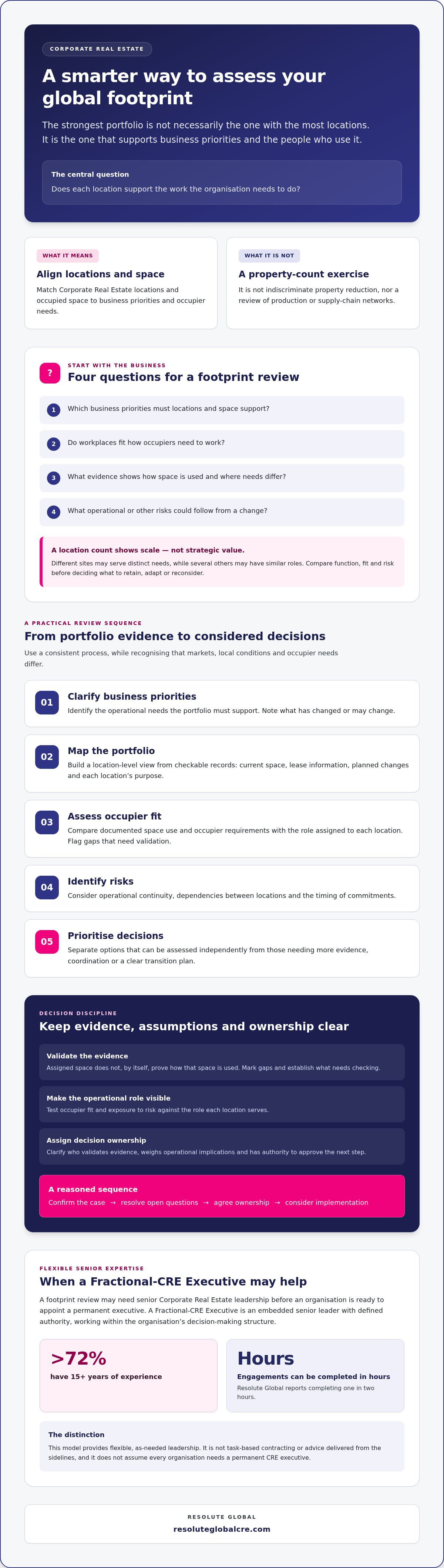
Begin with the business, not a property count. Establish what has changed, what the portfolio needs to support and where a mismatch or exposure may need attention. Ask:
• Which business priorities must locations and space support?
• Do current locations and workplaces fit how occupiers need to work?
• What evidence shows where space is being used, and where needs differ?
• What operational or other risks could follow from changing a location?
A location count shows scale, but not strategic value. Two sites may serve distinct operational or occupier needs, whilst several others may have similar roles. Without examining function, fit and risk, reducing the count could remove useful capacity or leave a more important mismatch unresolved. Make the trade-offs visible before deciding what to retain, adapt or reconsider.
How to assess and prioritise a global Corporate Real Estate footprint
A consistent review helps leaders compare locations without assuming that every market, property or occupier has the same role. Treat global footprint optimization as a sequence of evidence-led decisions, not a single instruction to cut space.
Clarify business priorities.
Identify the operational needs the portfolio must support, and note what has changed or may change.
Map the portfolio.
Assemble a location-level view using records leaders can check, such as current space, lease information, planned changes and the purpose each location serves.
Assess occupier fit.
Compare documented space use and occupier requirements with the role assigned to each location. Record gaps that need validation rather than treating assumptions as fact.
Identify risks.
Consider what could be affected by a proposed change, including operational continuity, dependencies between locations and the timing of commitments.
Prioritise decisions.
Separate options that can be assessed independently from those that rely on further evidence, coordination or a clear transition plan.
How can leaders turn portfolio evidence into priorities?
Use business priorities to guide each location-level decision, then test occupier fit and exposure to risk against the location’s operational role. Keep confirmed facts distinct from assumptions. For example, a record of assigned space does not, by itself, prove how that space is used. Mark gaps clearly and decide what evidence is needed before ranking options.
Assign decision ownership before changes begin. Identify who validates the evidence, who weighs operational implications and who has authority to approve the next step. This creates a reasoned sequence: confirm the case, resolve open questions, agree ownership, then consider implementation. If your organisation needs specialist input to structure that review, occupier-focused Corporate Real Estate guidance can help bring portfolio evidence and business priorities into sharper alignment.
When Fractional-CRE expertise can support global footprint decisions
A footprint review may call for senior Corporate Real Estate leadership before an organisation is ready to appoint a permanent executive. The Fractional-CRE Executive model provides access to experienced leadership on flexible, as-needed terms. These executives are embedded leaders with defined authority, not task-based contractors or consultants delivering recommendations from the sidelines.
That distinction matters during global footprint optimization. An embedded executive can work within the organisation’s decision-making structure, helping leaders connect portfolio choices with business priorities, occupier requirements and operational risk. > 72 % of Fractional Executives have 15+ years of experience. Resolute Global says engagements can be completed in hours (we’ve done it in two hours).
What should executives clarify before engaging Fractional-CRE support?
Start by defining the capability gap. Does the organisation need senior leadership to shape priorities, assess portfolio options or help move agreed decisions forward? Clarify the authority the role needs, who it will work with, and which decisions it can make or influence. Then agree how flexible the support needs to be as requirements evolve. Clear expectations help ensure the role is suited to the work, rather than treated as an undefined extra resource.
Resolute Global’s Fractional-CRE platform gives organisations access to a curated global community of former Corporate Real Estate Executives through its Fractional-CRE Executive model. For more information, visit www.ResoluteGlobalCRE.com, email james.mclean@resoluteglobalcre.com or call +44 7867 140785.
Discuss your Corporate Real Estate priorities
Put your Corporate Real Estate priorities into action
Effective global footprint optimization is not about reducing locations for the sake of it. It means testing whether each part of the portfolio supports business priorities, occupier needs and operational continuity, then using validated evidence to guide decisions. A clear review helps leaders compare options, separate facts from assumptions and identify where more analysis is needed.
When senior expertise would help, the Fractional-CRE Executive model offers an alternative to assuming a permanent appointment is essential. > 72 % of Fractional Executives have 15+ years of experience, and engagements can be completed in hours (we’ve done it in two hours).
Bring your priorities and open questions into a conversation about the right next step. Discuss your Corporate Real Estate priorities.
Frequently Asked Questions
What does global footprint optimization mean in Corporate Real Estate?
Global footprint optimization means aligning an organisation’s Corporate Real Estate locations and space with business priorities and occupier needs. It is not simply reducing the number of properties. A useful review considers the role each location plays, whether the space supports the people using it, and what operational risks a proposed change could create.
How do you assess a global Corporate Real Estate footprint?
Start by clarifying business priorities, then map the portfolio and assess how well each location fits occupier requirements. Identify potential risks and validate the evidence before ranking options. Separate confirmed facts from assumptions, note where more analysis is needed, and agree who owns each decision before changes proceed. This helps leaders compare locations without relying on property counts alone.
Can a Fractional-CRE Executive help with footprint optimization?
Yes. A Fractional-CRE Executive can provide embedded senior leadership with defined authority to support portfolio analysis, prioritisation and decisions. This is a leadership role, not task-based support, and can suit organisations that need senior expertise without assuming they need a permanent CRE executive. > 72 % of Fractional Executives have 15+ years of experience, and engagements can be completed in hours (we’ve done it in two hours).
How much does Fractional-CRE expertise cost compared with a full-time executive?
The annual cost figures are US$40k-US$120k for a Fractional Executive and US$200k-US$500k+ for a full-time C-suite executive. These are stated in US dollars, not UK prices or a quote for a specific engagement. Confirm the scope, authority and flexibility required when assessing which model fits your organisation.
Proudly Untraditional
We’re proudly untraditional in the way we think, operate, and deliver value in the Corporate Real Estate sector.
Whether you’re a client seeking a new experience or an independent real estate adviser please get in touch to learn more.
More from the field
Keep reading for more sharp analysis on global corporate real estate


