
Commercial Lease Negotiation: Strategic Guide for Tenants
A commercial lease is rarely a neutral contract; it is an asymmetric financial instrument engineered by institutional landlords to transfer capital expenditure and building obsolescence directly onto your balance sheet. When approaching commercial lease negotiation for tenants, relying on convention...


A commercial lease is rarely a neutral contract; it is an asymmetric financial instrument engineered by institutional landlords to transfer capital expenditure and building obsolescence directly onto your balance sheet. When approaching commercial lease negotiation for tenants, relying on conventional market intermediaries often leaves occupier priorities compromised against superior landlord intelligence. True advantage isn't found in standard compromises.
You already recognise that rigid lease durations, uncapped service charges, and punitive dilapidation liabilities can severely constrain commercial agility. By executing a deliberate Corporate Real Estate strategy, you'll eliminate costly landlord traps, secure lucrative rent-free incentives, and retain vital operational flexibility. Below, we examine the tactical steps needed to neutralise dual-agency conflicts, enforce robust break options, and align every square foot with your corporate future.
Key Takeaways
• Mastering commercial lease negotiation for tenants transforms property agreements from standard institutional templates into bespoke, value-generating assets.
• Dismantle landlord pricing control by engineering credible operational alternatives and creating unassailable transaction leverage before talks begin.
• Eliminate hidden financial liabilities by locking down Heads of Terms that explicitly restrict capital expenditure, service charge creep, and dilapidation exposure.
• Access elite, conflict-free Corporate Real Estate leadership on demand through agile fractional models without incurring permanent executive overheads.
The Strategic Fundamentals of Commercial Lease Negotiation for Tenants
Most enterprises treat property agreements as routine legal reviews. They dispatch drafts to external conveyancers who scrutinise boilerplate wording whilst missing the commercial landmines embedded within. Strategic commercial lease negotiation for tenants isn't an administrative closing task; it's a financial defence mechanism engineered to protect operating cashflow and long-term liquidity.
Institutional landlords rely heavily on this operational disconnect. While transactional solicitors confirm statutory compliance, sophisticated landlords exploit unrepresented occupiers to offload building depreciation, secure predictable yield, and institutionalise revenue streams. Real bargaining power demands dedicated Corporate Real Estate discipline. It connects floorplates directly to balance-sheet flexibility, preventing multi-year commitments from suffocating corporate agility.
Critical Commercial Clauses That Demand Rigorous Tenant Scrutiny
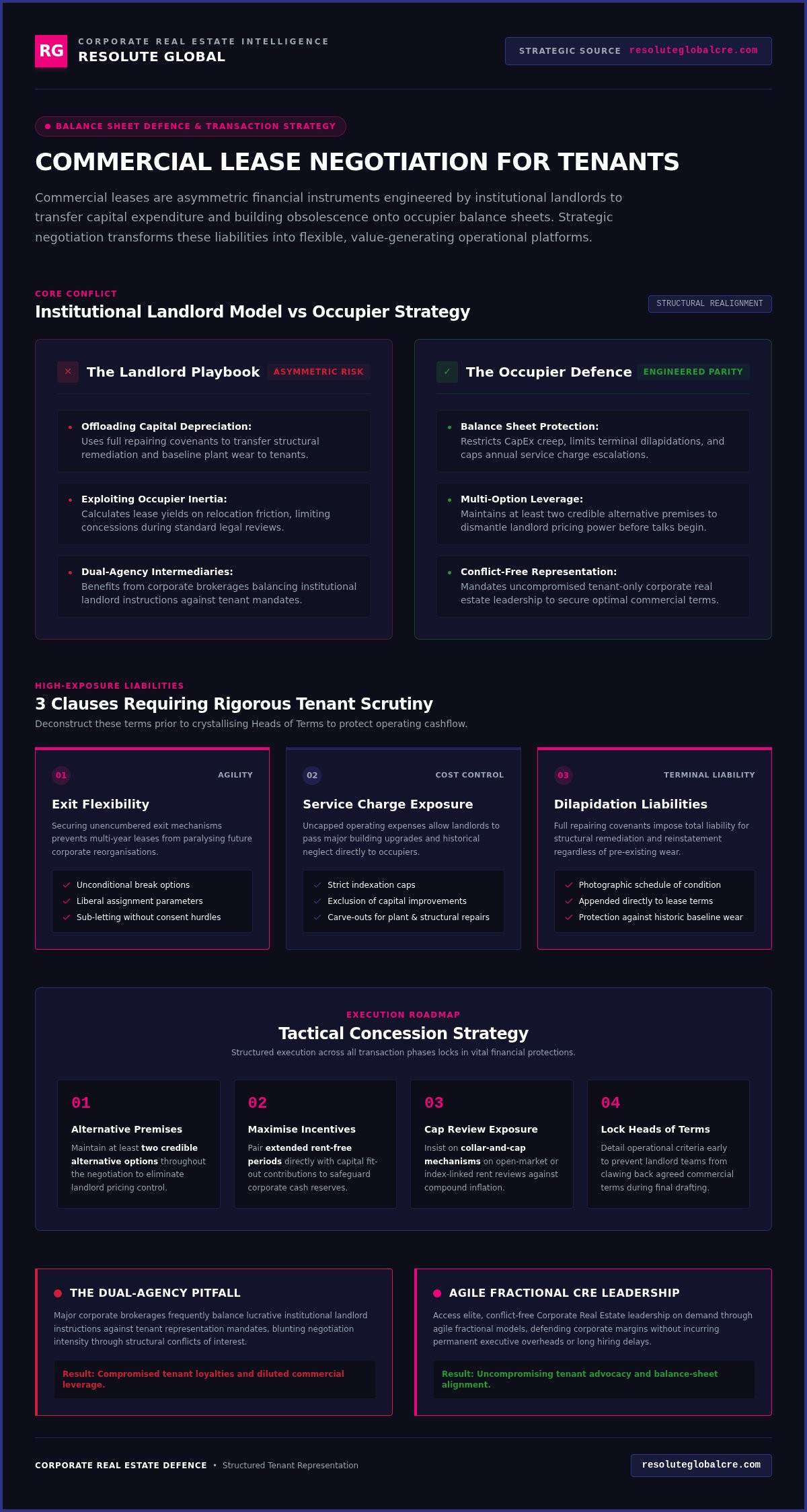
Institutional contracts obscure critical obligations behind seemingly standard language. Protecting your operational horizon requires deconstructing three high-exposure liabilities before Heads of Terms crystallise:
Exit Flexibility
Secure unconditional break rights, liberal assignment provisions, and sub-letting parameters without landlord consent hurdles that paralyse corporate restructuring.
Service Charge Exposure
Enforce strict indexation caps and exclude capital improvements, historic plant repairs, and structural expenditure from baseline operating costs.
Terminal Liabilities
Mitigate full repairing covenants using comprehensive photographic schedules of condition appended directly to the lease.
Under a full repairing and insuring lease, an occupier inherits total financial responsibility for structural remediation, ongoing mechanical maintenance, and building reinstatement, regardless of pre-existing baseline wear.
Executing an occupier-first strategy means negotiating these provisions as interconnected balance-sheet risks. When you control these terms early, you safeguard enterprise cash reserves long before draft documents circulate.
Executing the Negotiation Process: Building Uncompromising Leverage
Real leverage isn't requested; it's engineered. Institutional landlords calculate lease yields based on occupier inertia, knowing relocation carries operational friction. To execute successful commercial lease negotiation for tenants, you must maintain at least two credible alternative premises throughout the process. Meticulous Heads of Terms lock in vital commercial concessions, stopping landlord teams from clawing back agreed terms during detailed drafting.
Conventional agency models routinely undermine this advantage. Major corporate brokerages frequently balance lucrative institutional landlord instructions against tenant representation, blunting negotiation intensity through inherent dual-agency conflicts. True parity requires eliminating this bias entirely.
Tactical Steps to Secure Substantial Tenant Concessions
Capturing optimal terms requires structured, uncompromising execution across every transaction phase:
Maximise initial incentives
Pair extended rent-free periods with direct capital fit-out contributions to safeguard liquidity. As highlighted in this guide to commercial lease negotiation, detailing operational criteria early dictates commercial success.
Cap rent review exposure
Insist on collar-and-cap mechanisms on open-market or index-linked reviews to neutralise compound inflation exposure across the term.
Mandate complete independence
Never permit dual-agency representation. Retaining conflict-free Real Estate Solutions protects your balance sheet from compromised broker loyalties and ensures absolute strategic alignment.
Locking down these commercial protections early transforms your property commitment into a flexible operational platform rather than an unyielding corporate overhead.
Securing Agile Corporate Real Estate Expertise for Lease Transactions
Securing parity against institutional landlords demands seasoned Corporate Real Estate leadership, yet traditional executive recruitment takes months enterprises rarely have. When high-value acquisitions loom, standard organisations either burden overstretched internal teams or rely on transactional advisors lacking strategic context. Mastering commercial lease negotiation for tenants requires dedicated, embedded leaders who understand the landlord playbook and actively defend corporate margins.
Deploying Fractional Executive Leadership to Protect the Bottom Line
The Fractional-CRE model provides an agile alternative to permanent headcount, delivering high-tier acumen on demand. Rather than engaging task-based consultants, occupiers secure embedded leaders who integrate directly into governance structures. This approach reduces leadership expenditure by up to 60% compared to permanent C-suite appointments (US$40k-$120k vs US$200k-$500k+ annually). Crucially, over 72% of Fractional Executives bring 15+ years of senior industry experience to your side of the table.
Speed dictates leverage. While standard searches take quarters, fractional engagements deploy in hours, with documented completions within two hours to intercept aggressive landlord deadlines immediately. As detailed in the official Commercial Lease Guide for tenants, having experienced representation fundamentally changes transaction outcomes.
Partnering with Resolute Global ensures conflict-free Corporate Real Estate expertise tailored strictly to occupier resilience. You capture surgical deal execution, insulate operational capital, and conduct commercial lease negotiation for tenants with unwavering authority.
Take Command of Your Corporate Real Estate Strategy
Executing successful commercial lease negotiation for tenants means rejecting landlord-biased agreements and taking absolute control of your property liabilities. When you enforce rigorous dilapidation safeguards, restrict service charge creep, and engineer genuine market competition, your physical commitments actively support enterprise growth instead of draining liquid cashflow.
Securing this institutional leverage doesn't require permanent executive overhead. Agile occupiers now deploy vetted leaders with over 15 years of Corporate Real Estate experience within hours, capturing elite representation at up to 60% lower cost than traditional C-suite hires (US$40k-$120k vs US$200k-$500k+ annually). Ready to dismantle landlord dominance and safeguard your balance sheet? Secure Conflict-Free Corporate Real Estate Leadership With Resolute Global and negotiate every lease from a position of uncompromised strength.
Frequently Asked Questions
How early should tenants begin commercial lease negotiation before expiry?
Occupiers should initiate commercial lease negotiation for tenants between 12 and 18 months before expiry or break options fall due. This operational window allows sufficient time to inspect alternative buildings, evaluate spatial requirements, and establish genuine bargaining power. Starting late forces reactive decisions, handing institutional landlords total pricing dominance and removing your ability to structure advantageous relocation options.
Can a tenant negotiate out of a full repairing and insuring lease covenant?
Yes, tenants can successfully modify full repairing terms by negotiating a photographic Schedule of Condition into the final agreement. Rather than agreeing to hand back premises in pristine condition, your obligation is restricted to the building's entry state. Savvy occupiers also negotiate explicit carve-outs for pre-existing structural defects, inherent plant failures, and historic cladding liabilities to prevent unexpected balance-sheet exposure.
What is the primary difference between a tenant representative and a dual-agency broker?
A dedicated occupier representative works exclusively for the tenant, whereas a dual-agency broker balances competing instructions from landlords. That dual alignment creates an unavoidable conflict of interest. Traditional agencies don't want to compromise valuable landlord instructions across wider portfolios, which frequently dilutes their appetite to fight for maximum occupier concessions, rent-free terms, and operational flexibilities.
Why should businesses engage dedicated Corporate Real Estate expertise rather than relying solely on solicitors?
Solicitors ensure legal validity, but they don't establish commercial leverage or test market valuation bounds. Strategic commercial lease negotiation for tenants requires seasoned Corporate Real Estate leadership to design transaction strategy, structure rigorous Heads of Terms, and challenge landlord assumptions early. Conveyancers then document the commercial protections and operational freedoms your property leaders have already secured at the table.
Proudly Untraditional
We’re proudly untraditional in the way we think, operate, and deliver value in the Corporate Real Estate sector.
Whether you’re a client seeking a new experience or an independent real estate adviser please get in touch to learn more.
More from the field
Keep reading for more sharp analysis on global corporate real estate


