
Board-Level Examples of Corporate Property Liability Reporting
A board paper earns confidence when it makes property exposure visible, not merely technically correct. Effective board-level reporting on corporate property liabilities brings together the obligation, its financial accounting treatment, the effect of any adjustment on the income statement, and the...




A board paper earns confidence when it makes property exposure visible, not merely technically correct. Effective board-level reporting on corporate property liabilities brings together the obligation, its financial accounting treatment, the effect of any adjustment on the income statement, and the assumptions that explain the movement. Directors can then see what has changed, why it matters and where judgement shapes the figures.
Property liabilities arise from a range of commitments, so a single total rarely tells the whole story. Board papers should be concise while preserving the context directors need to scrutinise exposure and make decisions. Show liability balances and income-statement adjustments alongside clear explanations of what has changed, why it matters and what management needs from the board. Transparent reporting is more useful than dense schedules.
Key Takeaways
• Separate property obligations by type and show how each affects the balance sheet and income statement.
• Make accounting adjustments easier to interpret by pairing the figures with a concise explanation of the reason for each change.
• Structure board reporting around the liability’s valuation, key assumptions and relevant disclosures.
• Use clear, occupier-focused property insight to connect financial reporting with wider corporate real estate decisions.
Financial accounting
For board-level reporting on corporate property liabilities, first identify the reporting framework. UK public companies, private companies and charities may follow different frameworks and governance arrangements. State which basis applies and explain how it shapes the figures presented.
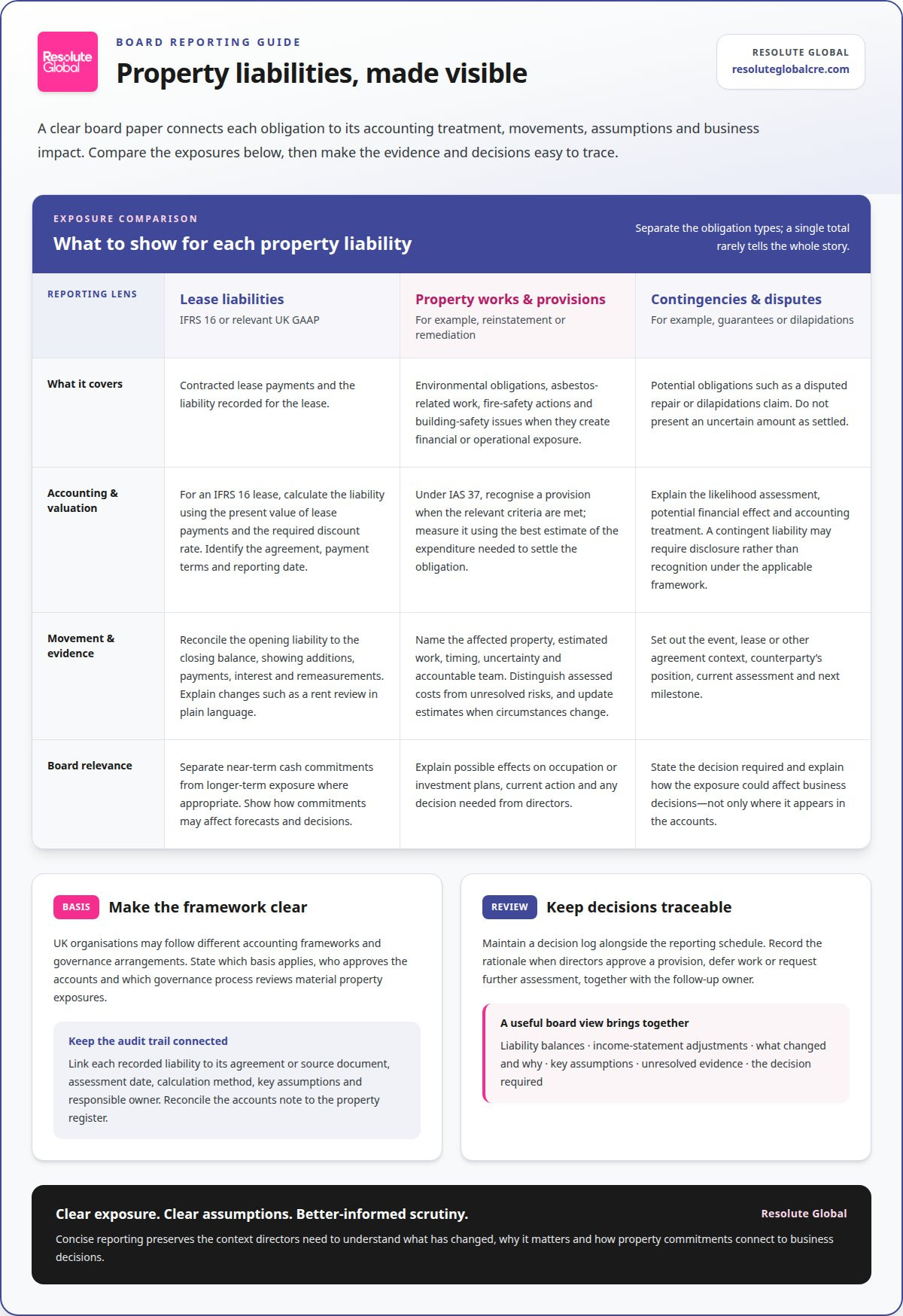
For leases, present the accounting under IFRS 16 or the relevant UK GAAP framework. Show the opening liability, additions, payments, interest and closing balance, separating near-term cash commitments from longer-term exposure where appropriate. Explain assumptions and movements in plain language.
Include environmental obligations, asbestos-related work, fire-safety actions and building-safety issues when they create financial or operational exposure. For each item, identify the affected property, estimated work, timing, uncertainty and accountable team. Distinguish assessed costs from unresolved risks.
For contingent liabilities, guarantees and disputes, explain the event, potential financial effect, likelihood assessment and decision required. A disputed dilapidations claim, for example, should set out the lease context, the counterparty’s position and the next milestone, without presenting an uncertain amount as settled.
Under-reporting can distort forecasts, hide cash requirements and leave directors unaware of operational constraints. A missed remediation obligation may also affect occupation or investment plans. Explain how each exposure could change business decisions, not just where it appears in the accounts.
Start with a property and lease register, then reconcile it against finance records, legal correspondence and facilities information. Give each liability an owner, evidence source, accounting treatment and review date. For example, a lease renewal may reveal an unrecorded reinstatement obligation. Finance and property teams can assess the lease and document an estimate, giving the board a clear view of the exposure, assumptions and decision required.
What are the UK legal and regulatory requirements for board reporting on property liabilities?
There is no single board-pack template for every UK organisation. The right approach depends on the entity’s legal form, accounting framework and property commitments. Record which framework applies, who approves the accounts and which governance process reviews material property exposures. Companies and charities may have different arrangements, so establish these before finalising the pack.
For each property, maintain an audit trail linking the lease or other agreement to the recorded liability. Include the source document, assessment date, calculation method, key assumptions and responsible owner. A lease renewal may change expected payments or reinstatement obligations. Record the change, explain its accounting treatment and show how it affects the board’s view of future commitments.
Keep financial reporting distinct from operational compliance updates, while showing how they connect. Fire-safety actions or building defects may require work, affect occupation plans and create financial exposure. Set out the issue, current action, accountable team and decision needed. For environmental or asbestos matters, explain the evidence behind any estimated obligation and distinguish confirmed work from unresolved risk.
Keep a decision log alongside the reporting schedule. If directors approve a provision, defer work or request further assessment, record the rationale and follow-up owner. This makes later changes traceable and supports clear discussion with finance, legal and property teams. For organisations managing complex portfolios across markets, global real estate advice can help connect property decisions with occupier priorities.
How should property liabilities be valued and disclosed in UK company accounts?
Begin with the accounting framework used for the company’s accounts. IFRS 16 addresses lease liabilities, while UK GAAP requirements depend on the applicable standard. Identify the agreement, payment terms and reporting date before calculating a balance. Consistent records make the figure traceable from contract to accounts.
For an IFRS 16 lease, calculate the liability using the present value of lease payments, applying the discount rate required by the standard. Maintain a schedule showing the opening balance, interest, payments, remeasurements and closing balance. For example, a rent review may change expected payments; document the revised inputs and resulting adjustment.
Assess property obligations beyond rent separately. Under IAS 37, a provision is recognised when the relevant recognition criteria are met, and measured using the best estimate of the expenditure required to settle the obligation. A lease-end reinstatement commitment, for instance, needs an evidence-based estimate and clear assumptions. Update the estimate when circumstances change.
Disclose material balances in the relevant notes, explaining their nature, expected timing and estimation uncertainty. Distinguish recognised provisions from contingent liabilities, which may require disclosure rather than recognition under the applicable framework. For a disputed repair claim, provide the background, current assessment and reason for its accounting treatment.
For board review, reconcile the accounts note to the property register and flag significant movements, judgements and unresolved evidence. Link each figure to its contract, calculation and owner. This makes scrutiny practical, not opaque. Discuss your corporate property commitments to connect portfolio decisions with occupier priorities.
Resolute Global
Resolute Global helps occupiers connect property commitments with wider real estate decisions through Occupier-focused CRE Guidance, a Global Real Estate Advisory Network and Conflict-free Real Estate Solutions. This perspective can help bring lease obligations, portfolio plans and operational priorities into the same board discussion.
Bring this perspective into discussions when property exposure spans locations, business units or changing occupancy needs. A clearer view of how commitments relate to workplace and portfolio decisions can help directors weigh broader implications alongside accounting treatment. This complements, but does not replace, financial and legal advice on company accounts.
Contact Resolute Global to discuss how property commitments fit your organisation’s real estate priorities.
Make property exposure part of strategic planning
Use the next board cycle to connect property commitments with changing organisational priorities. As locations, leases and operational needs evolve, reporting can help directors assess how property decisions affect flexibility, investment choices and future plans. Its value lies not only in recording exposure, but in making the implications visible while options remain open.
Keep the discussion active between reporting periods. Assign an owner to each material issue, record key assumptions and establish a route for escalating changes so management can bring decisions forward. This makes board-level reporting on corporate property liabilities a practical input to strategy, rather than a static accounting exercise.
Where property considerations need a broader occupier-focused perspective, Resolute Global can help connect real estate decisions with organisational priorities. Start a conversation with Resolute Global and take the next step towards more considered property decisions.
Frequently Asked Questions
What corporate property liabilities should be reported to the board in the UK?
Report liabilities that could affect the organisation’s finances, operations or property decisions. Alongside lease commitments and reinstatement obligations, consider unpaid business rates, other property liabilities, service-charge disagreements, guarantees, insurance claims and disputes with contractors or landlords. For example, flag a service-charge challenge if it could change a site’s forecast or renewal decision. Explain the exposure, its status and any decision required.
What key metrics and thresholds should a board-level property liabilities dashboard include?
Track recognised liabilities, upcoming cash commitments, changes since the previous report and unresolved exposures by property or business unit. Include lease expiries, break options and significant estimate changes when they inform decisions. Set escalation thresholds in line with the organisation’s materiality approach and risk appetite; no single threshold suits every portfolio. State the trigger and why it applies.
How often should corporate property liabilities be reported and who is accountable?
Align formal reporting with the board meeting cycle, and escalate material changes or urgent decisions between meetings through agreed governance channels. The finance lead can coordinate accounting figures, while property and legal leads provide supporting updates and evidence. Name one executive accountable for the consolidated report, and set out contributors and approval steps. This helps directors see who owns each action and when it will return for review.
How do property liability reporting practices differ for UK public companies, private companies and charities?
Accounting frameworks and governance arrangements can differ. Identify the applicable framework, who approves the accounts and which governance process reviews material property exposures before finalising the board pack.
Proudly Untraditional
We’re proudly untraditional in the way we think, operate, and deliver value in the Corporate Real Estate sector.
Whether you’re a client seeking a new experience or an independent real estate adviser please get in touch to learn more.
More from the field
Keep reading for more sharp analysis on global corporate real estate


